
Two essays have been dominating my feed over the past few weeks — and probably yours too.
The first, from Matt Shumer, is a co-founder's confessional that got 50 million views: AI has already replaced him at his own technical job, he says, and everyone else is next — in one to five years! 🤯
The second, from Citrini Research, is a meticulous fictional scenario set in June 2028: AI has triggered a cascading economic collapse, unemployment is at 10.2%, the S&P 500 is down 38%, and a $13 trillion mortgage market is threatening to crack... 😬
Both are well-written. Both contain real insights. But, fundamentally, both are designed to make you panic. Because what drives more clicks than anxiety? 🤦♂️
So I want to offer you something more useful than fear.
Because I've had a front-row seat to two of the biggest labor market disruptions of the 21st century. The first was LinkedIn — I got to watch it transform the entire hiring landscape in real time. The second is AI. And here's the pattern I've seen play out in both disruptions, every single time:
Every major disruption produces three types of people. Two of them lose. One of them wins.
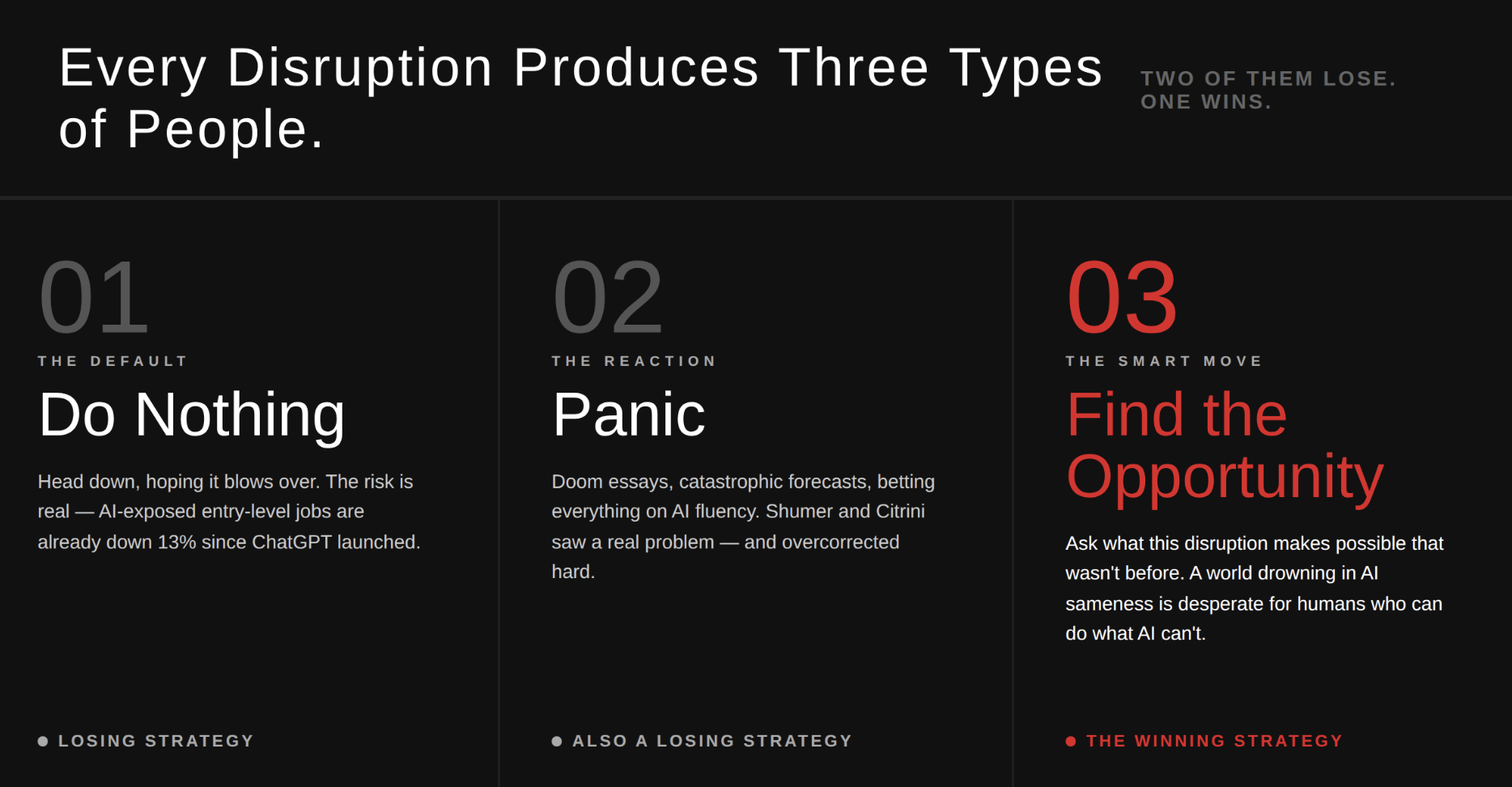
Shumer and Citrini are writing for the first type: The people who are doing nothing — heads down, hoping this blows over. And their warning is legitimate: that approach will cost you.
But the solution isn't to panic. It's to find the opportunity. Here's how...
The Default Response: Do Nothing
Let's be honest about why the doom essays exist. They're reacting to something real.
A lot of people are still treating AI the way they treated LinkedIn in 2004 — ignoring it, or doing the bare minimum, or assuming their particular job, industry, and skill set are basically fine.
Some of them are right. For now.
But the Stanford economist Erik Brynjolfsson — working with actual ADP payroll data from millions of real workers — found that entry-level employment in the most AI-exposed fields has already dropped 13% since ChatGPT launched. Software developer employment for workers ages 22-25 is down nearly 20%.
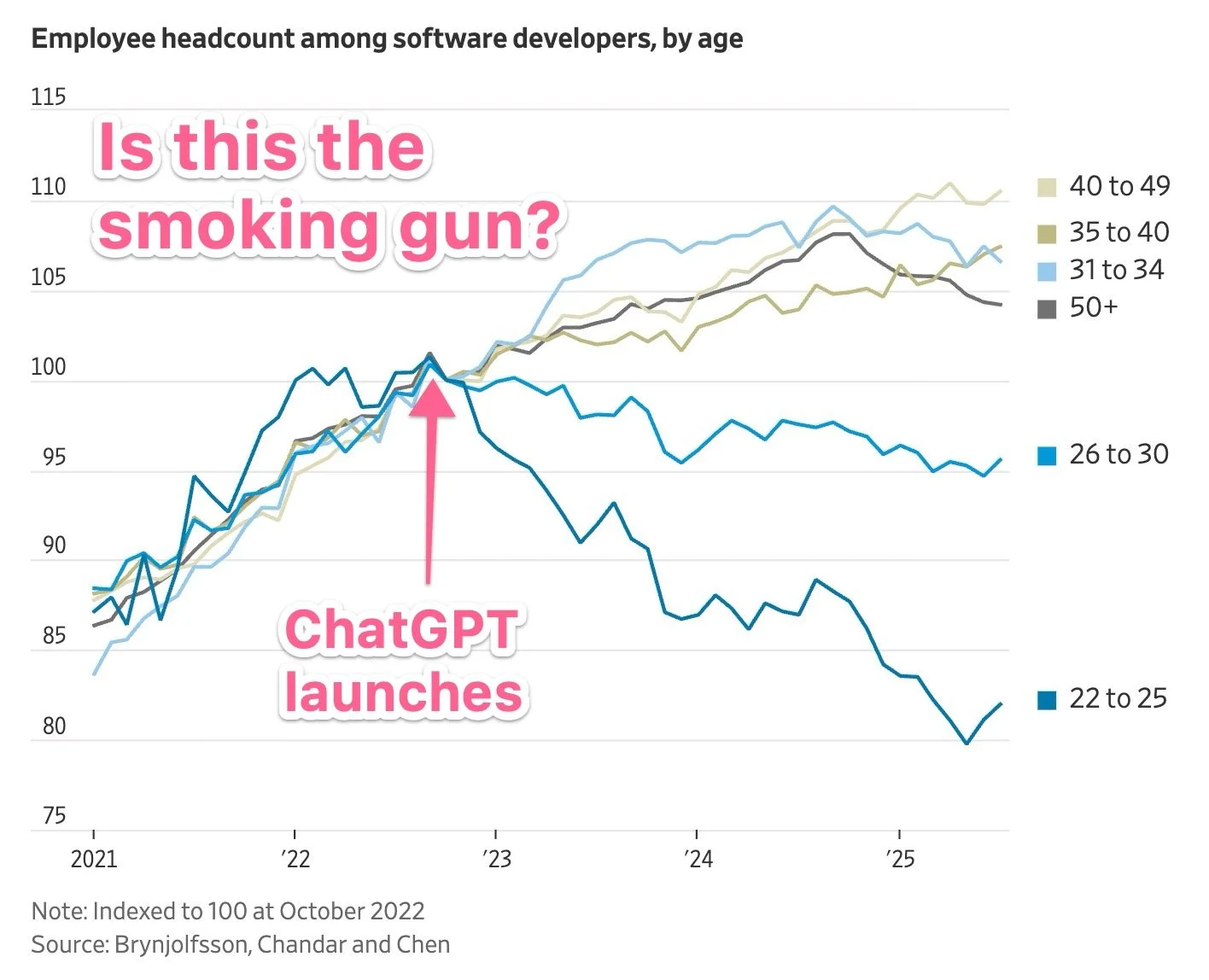
Not because AI replaced all those people. Because companies are increasingly hiring one person who can do the job with AI over two people who can do it without.
So yes — Do Nothing is a losing strategy. Shumer and Citrini are right to sound the alarm on that.
But then they overcorrect. Hard.
The Panic Response: Why the Viral Essays Get It Wrong
Before you sell your SaaS stocks, pivot your entire career into vibe-coding, or conclude that human skills are done and AI fluency is the only thing that matters — let's actually look at the evidence the doom narrative rests on. It's shakier than it looks.
The Bar Exam Myth
The Shumer essay follows a long tradition of AI hype that leans on one headline stat: AI scored in the 90th percentile on the bar exam! 😮
MIT researcher Eric Martínez actually dug into the methodology. The 90th percentile figure was calculated by comparing GPT-4 to repeat bar takers — people who had already failed the exam at least once. Compared to first-time test-takers, GPT-4 landed in the 48th percentile. And on the essay section — the part that most closely resembles what practicing lawyers actually do, with the contextual judgment and nuanced reasoning real legal work requires — GPT-4's performance fell to the bottom 15th percentile compared to licensed attorneys.
The headline "AI aced the bar exam" was really: "AI performed worse than 85% of working lawyers on the tasks that most resemble actual lawyering."
The METR Graph Everyone Is Misreading
The other data driving the doom cycle is METR's "time horizons" graph — AI's ability to complete increasingly long tasks is doubling every four to seven months, suggesting AI completing weeks-long tasks by 2028.
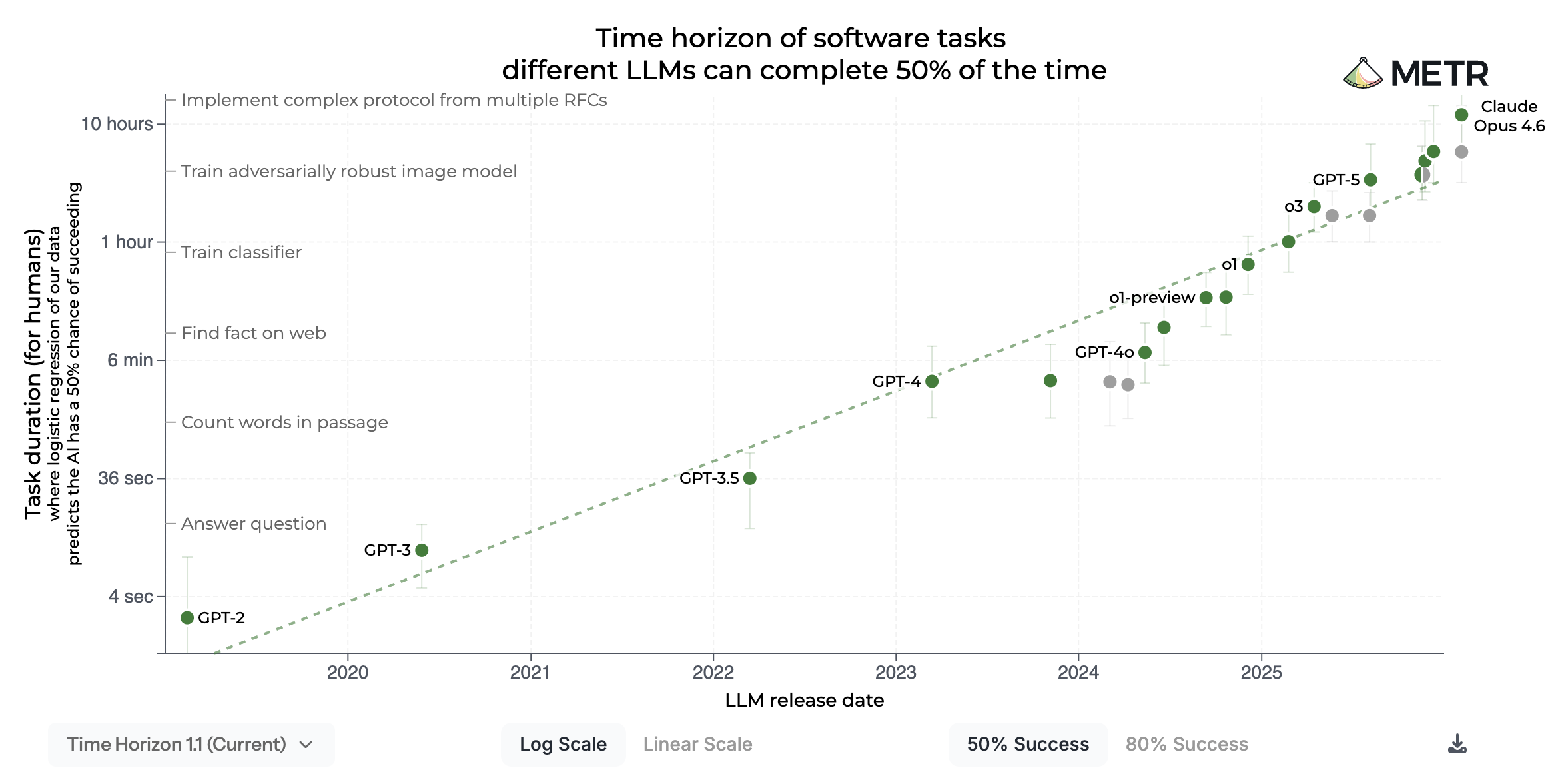
What the graph actually measures: coding tasks. Only coding tasks. The most structured, verifiable, well-defined type of knowledge work that exists. And even within that narrow slice, the benchmark success threshold is 50% — meaning AI fails half the time in its own benchmark. That would get a junior hire fired in their first week!
More tellingly: METR ran a randomized controlled trial of experienced developers working on real complex codebases — not clean benchmark tasks. Result? AI tools produced a 19% net slowdown compared to unassisted work. The developers felt 20% faster. They were measurably slower. The messier and more human the real-world problem, the wider the gap between AI's benchmark performance and what it delivers in the wild.

What the Citrini Scenario Requires
Citrini's 2028 collapse hinges on AI displacing white-collar workers broadly and quickly enough to crater consumer spending in a cascading feedback loop. But the Stanford payroll data tells a far more surgical story.
Yes, AI is eliminating jobs. But a particular kind: entry-level, rote, codified work. Boilerplate coding. Scripted customer support. Formulaic analysis. The most algorithmic slice of white-collar work. Meanwhile, experienced workers in those same fields show stable or growing employment. And in fields where AI augments human judgment rather than replacing it, hiring has continued rising across all experience levels.
The canary in the coal mine isn't dying because there's no oxygen left for everyone. It's dying because it was always the most exposed.
The Smart Response: Find the Opportunity
Here's where I know I've seen this before.
When LinkedIn went mainstream, the people who panicked made a predictable mistake. They hired expensive profile writers, chased random connections, collected endorsements for skills they barely had — optimizing hard for the wrong signals because those felt like urgent action. They stayed exhaustingly busy. They got almost no results.
The people who thrived asked a different question: not "how do I survive LinkedIn?" but "what does LinkedIn make possible that wasn't possible before?" The answer was stunning. For the first time in history, you didn't need to go to the right school or know the right people to reach a hiring manager at a great company. LinkedIn had demolished the old boys' network. Anyone, anywhere, could build real relationships directly with people who had the power to hire them.
That was a massive opportunity. For anyone bold enough to see it.
AI is offering the same kind of opening right now. You just have to know where to look.
The Bottleneck Is Moving
Every economy runs on a value creation chain: Idea → Development → Distribution. For the past 25 years, the scarce and therefore expensive bottleneck in that chain was development — technical skills. Ideas were cheap and distribution was increasingly affordable, but building the thing required rare, expensive human talent. That's why the best time to be a software engineer was basically every year since 1995.
When AI can write competent code, draft documents, and generate polished first drafts of almost anything, technical development stops being the scarce bottleneck. The scarcity moves. To the idea side of the chain — creativity, taste, genuine understanding of what humans actually want. And to the distribution side — storytelling, communication, the ability to build real trust with real people who have no particular obligation to listen to you.
The scarcest thing in a world drowning in AI-generated output isn't more AI-generated output.
It's the human stuff that AI can't genuinely be.
What This Looks Like in Practice
Let me make this concrete.
Last year, I was hiring a Virtual Assistant for my company. Standard role — coordinate outreach, keep operations humming. I posted the job and got 200 applications.
Perfect grammar. Polished formatting. All clearly AI-generated using some variation of the same prompt: "I am writing to express my enthusiastic interest... My extensive experience in administrative support, coupled with my passion for organizational excellence..."
They all checked the boxes. They were all, technically, fine. And reading through them, I felt a creeping dread — not because they were bad, but because they were completely interchangeable. A hundred different people who had all decided the safest play was to let AI produce something perfectly adequate. Something that wouldn't get rejected. Something that would absolutely not get them hired.
Then I got to application #198. It was from Rose.
Instead of corporate-speak, she wrote about why she wanted this specific role. She'd clearly researched The Job Insiders. She pointed out gaps in our content strategy, suggested specific improvements, and questioned whether I was thinking too small about the role.
I brought her in for an interview expecting a standard conversation. Instead, she challenged me: "Why aren't you getting your voice out there more? You've got this amazing expertise, but you're basically invisible online. If I'm going to help you, we need to think bigger than just scheduling."
I hired her on the spot.
Over the next year, Rose took ownership of challenges that weren't in her job description, questioned assumptions I'd held for years, pushed me to write a book, and built us a podcast from scratch — all things I'd been told required a bigger team. Not because she was told to. Because she saw what was needed and went and got it done.
The 197 AI-generated applications are the Panic response: using AI as a substitute for actually showing up. Rose is the Opportunity response — someone who understood that a world full of AI-polished sameness creates a massive opening for genuine human curiosity, drive, and judgment.
PwC analyzed close to a billion job postings across six continents and found that workers who combine human strengths with AI fluency already command a 56% wage premium — in the same role, at the same company. That number was 25% just a year earlier. The market is pricing the Rose approach at an accelerating premium. And the gap is widening.
How to Get There (The SURF Framework)
The book Rose encouraged me to write — Unbreakable — is built around a framework I call SURF. Because the right response to a tidal wave isn't to run from it, and it isn't to freeze. It's to learn to ride it:
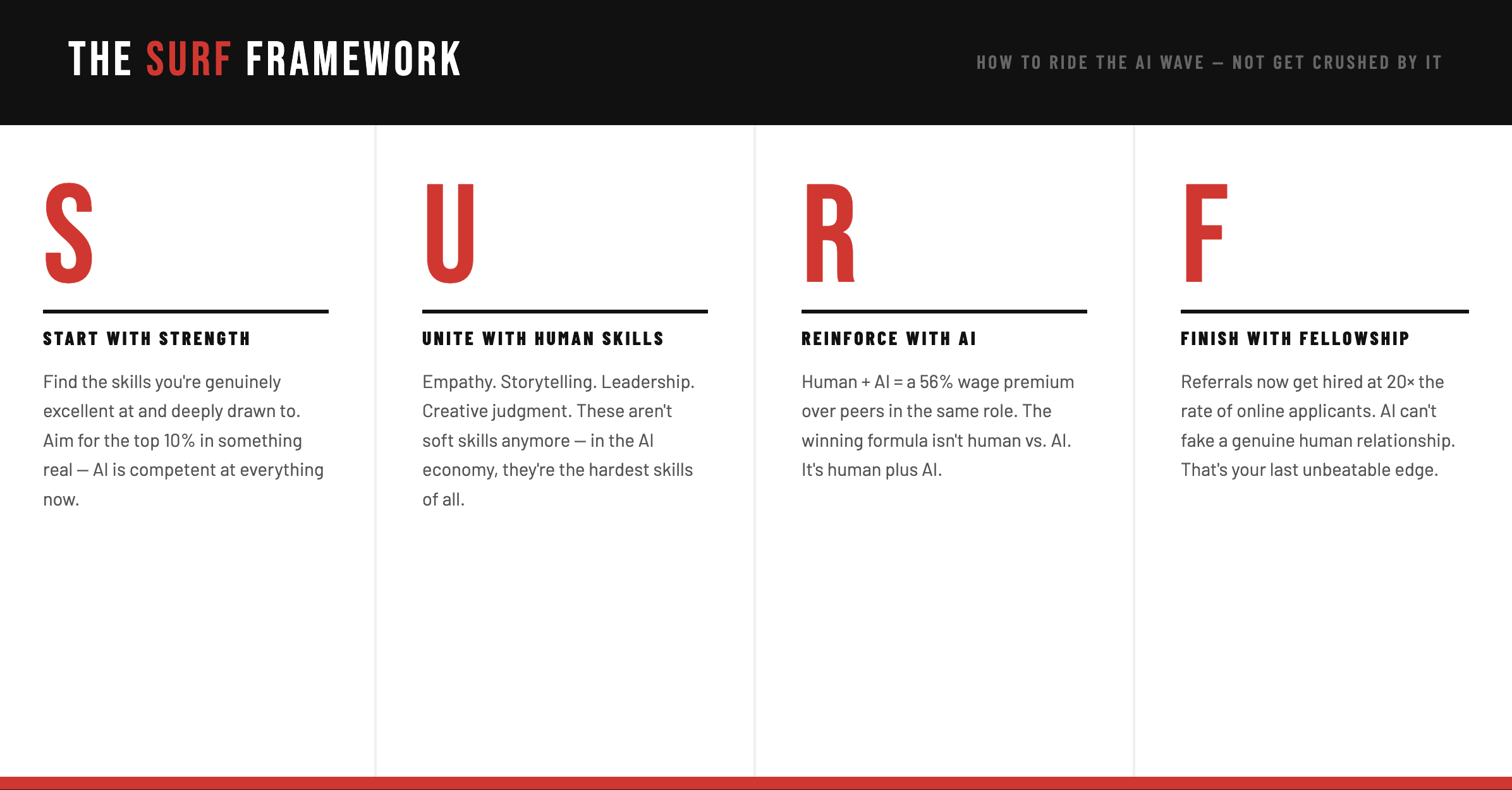
S — Start with Strength. Find the skills you're genuinely excellent at and deeply drawn to. Because AI is now competent at almost everything, you need to aim for the top 10% at something to give yourself a real margin. The only sustainable path there is work you're naturally wired for. One warning: resist the temptation to outsource your core strengths to AI — research shows that skills atrophy with over-reliance on AI assistance. That particular shortcut leads off a cliff.
U — Unite with Uniquely Human Skills. Your strengths can't only be things AI can replicate — formulaic writing, boilerplate code, scripted analysis. They also have to include what AI can't genuinely be: empathy, storytelling, leadership, the creative judgment to see what's broken and fix it before anyone told you to. These are the skills LinkedIn's 2025 Workplace Learning Report found at the top of every organization's priority list — at the exact moment AI was supposedly making them obsolete. They're not soft skills anymore. In the AI economy, they're the hardest skills of all.
R — Reinforce with Relevant AI. The winning formula isn't human versus AI. It's human plus AI. The designer who brings storytelling instinct and can wield AI to produce agency-quality work solo. The consultant who brings strategic judgment and uses AI to compress weeks of analysis into an afternoon. The writer with a unique voice who uses AI to research faster and outline smarter. That 56% wage premium? That's the market pricing this combination today. In five years it'll be the floor just to compete.
F — Finish with Fellowship. Here's what both viral essays miss entirely: our human algorithms for hiring have never been meritocratic. We don't hire the best person for the job. We hire the person we like and trust most. And in a world where AI has compromised every signal recruiters used to rely on — AI-generated resumes, AI-coached interview answers, AI-polished portfolios — the one thing that can't be faked is a genuine human relationship. In 2016, referred candidates were hired at 9X the rate of online applicants. By 2025, that gap had grown to 20X. AI isn't making human connections less important. It's making them the last thing left that's truly real.
The Bottom Line
Shumer and Citrini are right that doing nothing is a losing strategy. The disruption is real and the people who ignore it will pay for that.
But the answer to "don't do nothing" isn't panic — and it certainly isn't betting everything on worst-case scenarios that the best available data doesn't actually support.
The answer is what the smart LinkedIn users figured out a generation ago: ask what the disruption makes possible that wasn't possible before, then go build it.
A world drowning in AI-generated sameness is desperate for humans who can do what AI can't. People who genuinely understand other humans. People who can lead when there's no script. People who can build real trust in a world full of synthetic content. People like Rose.
Those people are not getting replaced.
Those people are going to be the most valuable professionals in the world.
The tidal wave is real. You are not helpless in front of it.
Find the opportunity. Surf.
Jeremy Schifeling is the founder of The Job Insiders and the author of Unbreakable: How to AI-Proof Your Job Search, Career, and Future.